Introduction:
When planning luxury car aftermarket carbon fiber upgrades, are you troubled by the choice between dry carbon fiber vs wet carbon fiber? Accurate material specification is crucial for controlling project budgets and optimizing procurement lead times. This article provides a comprehensive technical analysis to help your business in selecting the most suitable materials.
What is Wet Carbon Fiber?
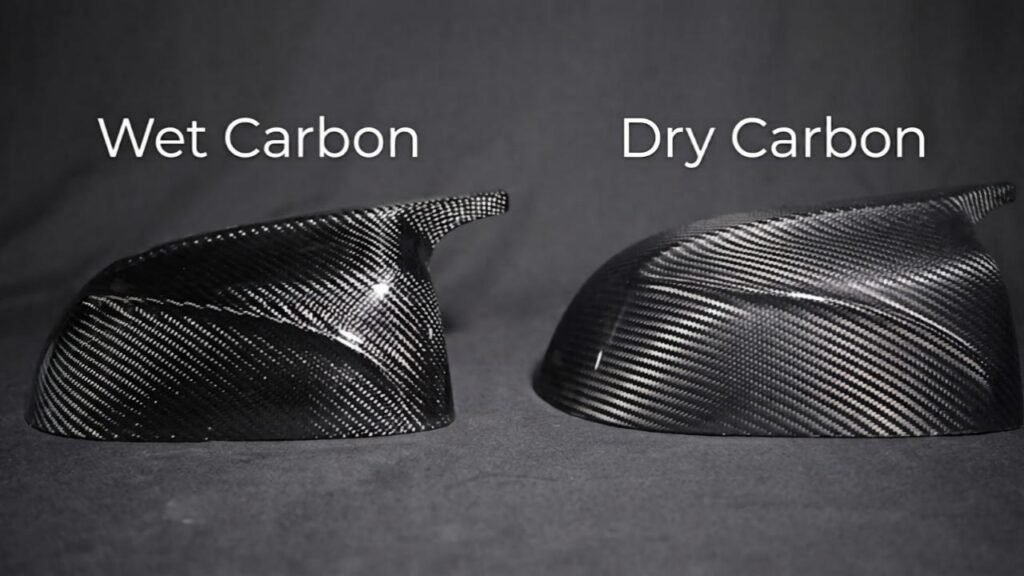
Wet carbon is an extremely common material in the tuning world. It is made by laying dry carbon fiber cloth onto a dedicated mold, then applying resin manually by brushing or infusion, and finally curing under low pressure.In essence, wet carbon is the process of attaching carbon fiber onto auto parts, typically consisting of a fiberglass base and an outer layer of carbon fiber cloth with resin.
What is Dry Carbon Fiber?
Dry carbon refers to carbon fiber parts made using the prepreg dry carbon fiber manufacturing process.. The carbon fiber cloth is pre-impregnated with resin and processed into prepreg sheets. During production, the prepreg is placed into a mold, and finally cured under high temperature and pressure in an autoclave. Dry carbon is a type of carbon fiber part that cannot be made by hand. So,The process is completed in one go, requiring only one step from the semi-finished product to the finished part.
Wet vs. Dry Carbon Fiber: The Ultimate Comparison
Weight
Material lightweighting affects vehicle performance.
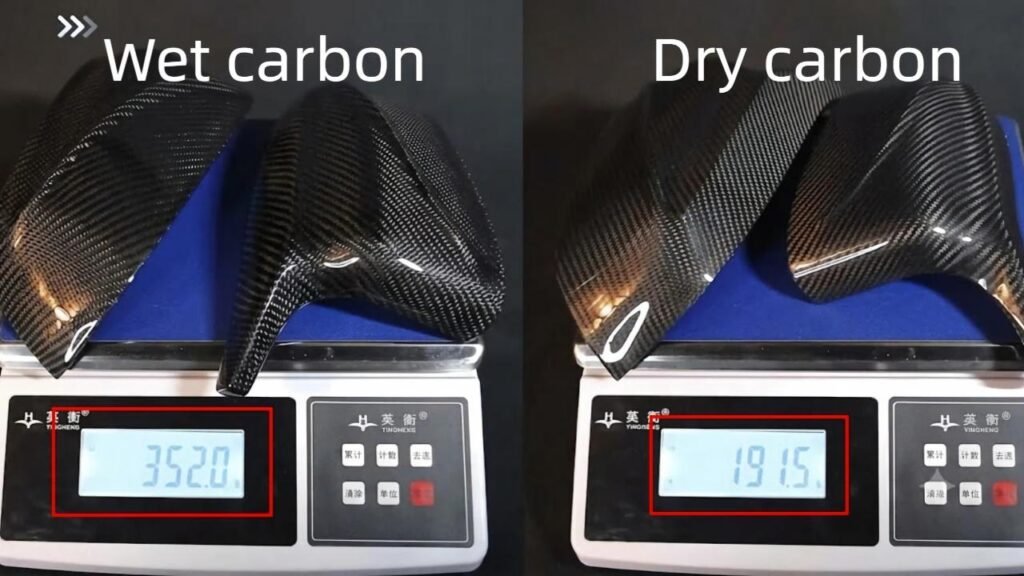
Wet carbon lacks the step of removing excess resin under high pressure, so the finished part is relatively heavy. For a supercar, the total weight of a wet carbon body kit may even exceed that of the OEM parts.
In contrast, dry carbon fiber vs wet, in the high-temperature and high-pressure autoclave, precisely controls the resin content to the minimum.Therefore, when looking at the wet vs dry carbon fiber weight difference, dry carbon is typically more than 40%-70% lighter than wet carbon for the exact same product.For instance, a standard wet carbon front bumper might weigh around 5kg (11 lbs). While the exact same pre-preg dry carbon version weighs only 1.5kg to 2kg (3.3 to 4.4 lbs).
Strength
Ability to resist fracture when subjected to strong external impact.
Strength refers to the Limited by its process, the bubbles in the resin of wet carbon are unevenly distributed, forming multiple stress concentration points. Even with everyday bumps, the weak points may develop radial cracks.
But,In dry carbon fiber, the fiber molecules are tightly bonded with the resin, with no excess interference, to achieve the highest strength.
Rigidity
Rigidity≠Strength,Rigidity is the ability to resist deformation.
wet carbon fiber vs dry has weaker rigidity. According to experiments, when your driving speed exceeds 200 km/h, a bumper made of wet carbon will undergo varying degrees of bending deformation.
The rigidity of dry carbon fiber rivals aerospace-grade materials, combining airflow with aerodynamics to always maintain the posture of the part itself.
Weave Distortion
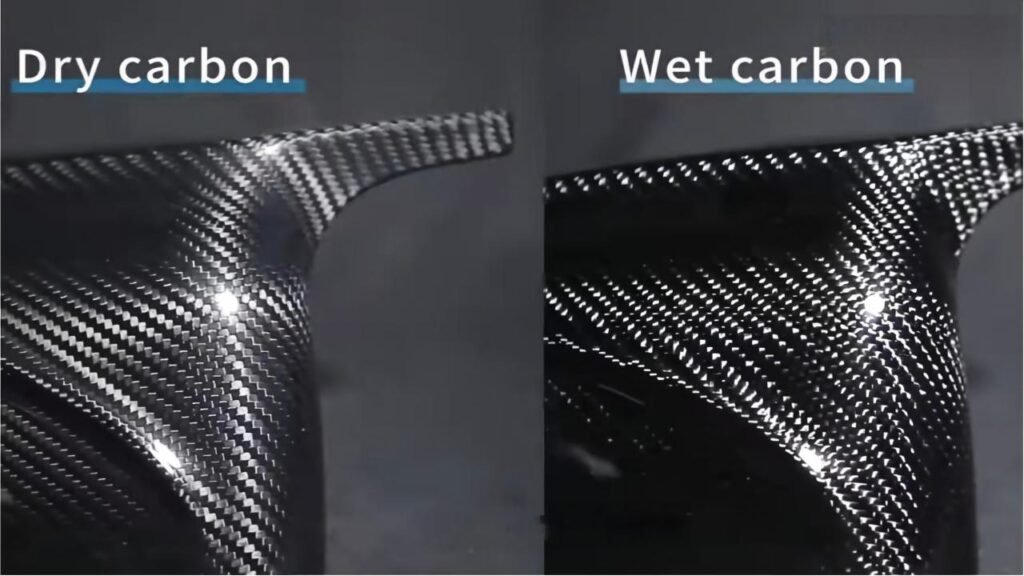
With wet carbon, due to manual handling of the carbon fiber cloth, no matter how careful you are, problems such as pulling and twisting will inevitably occur, creating a visual “cheap look.” The excess resin structure smeared on the surface of the part will also inevitably bring a heavy, murky feeling.
Corresponding,dry carbon perfectly avoids all problems of manual intervention. There will be no phenomenon of texture twisting. The final surface effect is absolutely symmetrical, the texture is perfectly fixed, and it has a high-end 3D texture pattern.Whether demand the classic 2×2 Twill Weave, a 1×1 Plain Weave, or the highly sought-after Forged Carbon look, pre-preg dry carbon ensures a flawless, premium finish every time.
Fitment
100% perfect fit can reduce your installation costs.
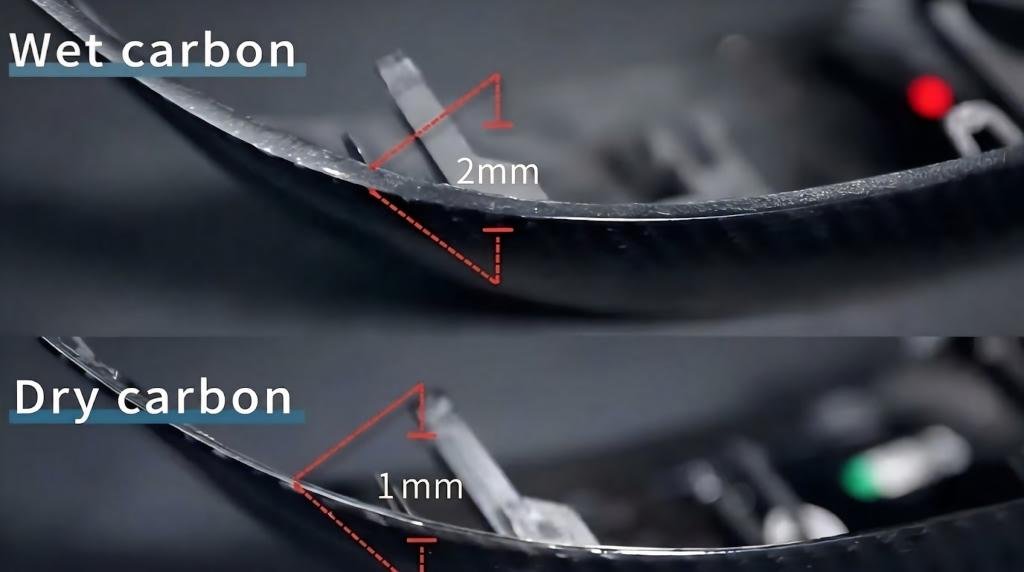
Wet carbon parts are products of low temperature and low pressure. Their relatively brittle hardness and rigidity can very easily undergo deformation from thermal expansion and contraction in special environments. Excessive accumulation of resin can also cause uneven edge thickness. Even the most highly skilled technician will have to grind the part according to the degree of deformation.In more severe cases, re-cut and re-align it.
The dimensions of dry carbon fiber achieve millimeter-level precision.This achieves a plug and play dry carbon aero parts experience in any situation, saving highly valuable labor hours for tuning shops.
Cost & Price
Why is the price of dry carbon so much more expensive than wet carbon?
Compare wet vs dry carbon fiber manufacturing cost, the production threshold for wet carbon is relatively low.Thus,Wet carbon’s molds are mainly made of cheap fiberglass, and a high-temperature and high-pressure environment is not required. Overall, the cost is relatively low.
In contrast, the production of dry carbon is extremely demanding. The autoclave alone costs several million RMB, and it also requires supporting professional metal molds and low-temperature cold storageThese professional equipment produce dry carbon parts with higher performance.
Common Application
Generally speaking, wet carbon fiber material is more suitable for daily modifications of mid-range car models(such as mirror cover), and for entry-level modifiers who do not have high requirements for stress and performance.
For supercars such as Ferrari, Bentley, and Lamborghini, dry carbon fiber aerodynamic upgrades are the inevitable choice, and all owners will unhesitatingly choose high-performance modifications.
Conclusion: Which Material is Right for Your Inventory?
In summary, from multiple aspects such as physical performance and aesthetic performance, this article explains a detailed comparison between dry carbon and wet carbon, helping you clarify your own needs and make the right decision.
| Feature | Wet Carbon Fiber | Dry Carbon (Pre-preg) |
| Process | Dry carbon cloth+hand lay-up/infusion + low temp and low pressure cure | Prepreg + high temp and high pressure |
| Weight | Heavy | Ultra-light |
| Strength | Moderate | Maximum |
| Rigidity | Low | Aerospace-grade |
| Weave | Wavy & inconsistent | Perfectly symmetrical |
| Fitment | Requires adjustments | 100% Plug & Play |
| Cost & Price | Low cost | Premium price |
| Application | Entry-level / Budget builds | Luxury cars /Supercars |
FAQ
1. Q:Does Shanghai CS Auto Parts Co., Ltd. Provide Wet Carbon Products or Dry Carbon Products?
A: As a leading aftermarket carbon fiber parts supplier,we have both dry carbon products and wet carbon products, we will recommend the product with the most suitable material for you based on your modification or repair needs. When you need Bulk custom orders or or wholesale dry carbon fiber body kits, the material can also be customized.But no matter what material the product is, the quality will be guaranteed.
2. Q: How Can Distinguish True Dry Carbon Fiber from Wet Carbon Fiber?
A:The most intuitive methods are two.
①Compare the weight. For products of the same volume, dry carbon material will be lighter in weight.
②Visual comparison. True dry carbon fiber typically has a clean, matte, resin-free backing, with the fabric weave visible inside due to the vacuum bagging process.
Wet carbon fiber, on the other hand, typically has a glossy, thick and irregular resin layer on the inner side, sometimes mixed with fiberglass reinforcement.
3. Q:What Happens to Dry Carbon and Wet Carbon under Prolonged Exposure to Sunlight? Which Material Has Stronger UV Resistance?
A:When exposed to sunlight for a long time, yellowing and degradation will occur, but this is not caused by the carbon fiber itself. Rather, UV radiation attacks the resin part and the surface clear coat layer, triggering the photo-oxidation process. But overall, dry carbon fiber inherently has stronger UV resistance than wet carbon fiber.
4. Q:How to Prevent Carbon Fiber Products from Yellowing and Degrading?
A:Here is a summary of four protection methods.
①Paint Protection Film (PPF): Apply a transparent, UV-resistant PPF layer on the carbon fiber surface. It physically blocks UV rays, prevents scratches .
②Ceramic Coating: Applied to the surface, it bonds with the clear coat to form a micron-level protective layer.
③Regular Waxing and Sealants: Every few months, care for the surface using a synthetic automotive sealant .
④Sun Shade and Garage Parking: The simplest and most effective advice is to minimize continuous exposure to sunlight. Parking the vehicle in a garage or using a UV-protective car cove.
5. Q:If a Carbon Fiber Product Gets Bumped or Scratched, Which Material is Easier to Repair?
A:Wet carbon is easier to repair.
Wet carbon has a thicker liquid resin and clear coat layer, providing enough room for wet sanding, polishing, or re-applying clear coat, making repair relatively easy.
Dry carbon fiber, due to its precise manufacturing process, results in an extremely thin resin layer. If sanded with sandpaper, it is very likely to directly cut into the original carbon fiber fabric,once the fabric has frayed edges or is damaged, its aesthetic pattern will be permanently damaged.
Final Thoughts
Finally,both wet carbon and dry carbon have their unique advantages and market value. Shanghai Bamboo carbon fiber products provide a 1:1 OEM fitment, with a large inventory. To support our B2B partners, we offer flexible Minimum Order Quantities and OEM & ODM Carbon Services. Please browse our website and contact us today!